Have you ever tried to work in your office while it is a huge mess? There are papers everywhere. You’re trying to be productive and creative but you can’t find that one piece of paper you’re looking for and you just spilled your coffee trying to look for a pen. How does it affect your mental state and productivity?
Now imagine you’re a child going into your play area. It may even look tidy but there are dozens and dozens of toys inside baskets so in order to find the one toy you’re looking for you have to dump everything on the floor. It becomes messy pretty quickly. And now there’s barely any clear surface to work on. To explore. To create. To build that big tower you had in mind with your favorite new blocks.
Play is the work of the child. It is how children explore and make sense of the world around them. It is how they learn. And as such, their play space should be inviting, clutter-free, inspiring, and their play time viewed as sacred. Having a functional, orderly and inspiring play area is an important foundation for quality play.
A 2018 study entitled “The influence of the number of toys in the environment on toddlers’ play”, published in the journal Infant Behavior and Development, confirmed that having too many toys in the environment reduces the quality of play. Conversely, fewer toys led to increased focus and more creative and imaginative play, as well as deeper cognitive development.
In addition to reducing the quality of play, too many toys can also affect concentration – a critical skill to start building in toddlerhood – and may even become overwhelming (too many choices) and overstimulating. This is particularly true if there are too many active toys featuring flashing lights and loud sounds.
So how can you create a peaceful play area?
I use a three-part process with the parents I work with, which I’m going to share with you now.
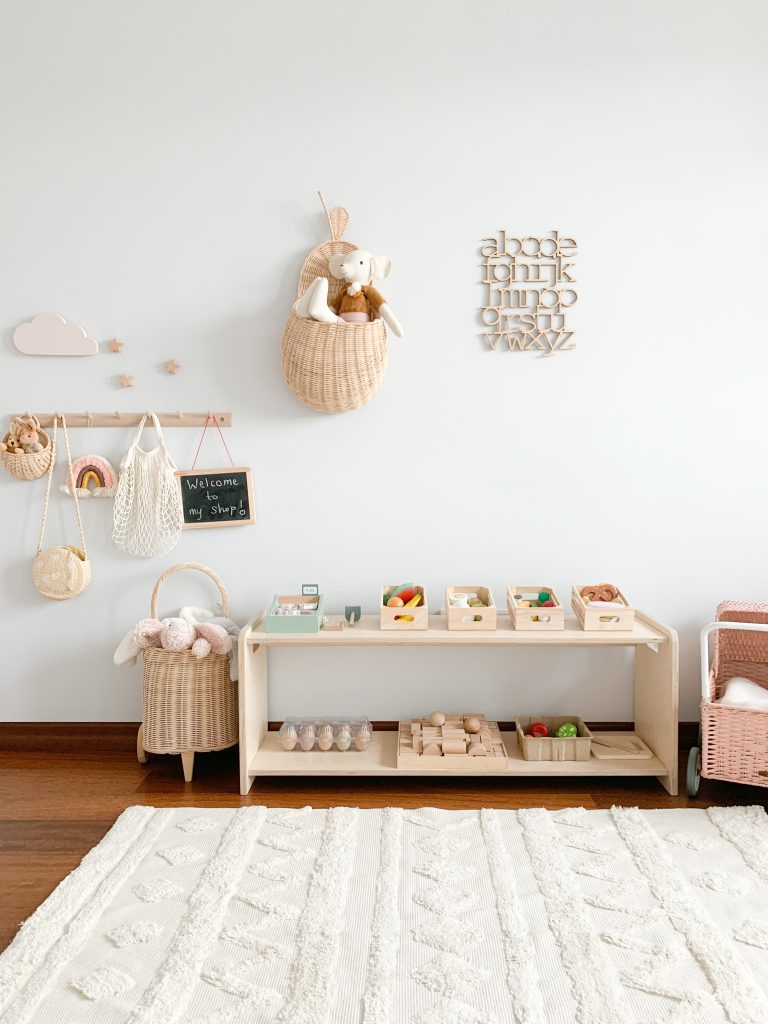
This is the most time-consuming part but also most rewarding. Start by sorting all of your child’s toys, books and materials into three piles. The items that the child has outgrown and is no longer showing an interest in can be sorted into a donating pile or stored away for a younger sibling. The items that are still developmentally-appropriate but the child hasn’t shown much interest in, in the past few weeks, can be stored and rotated later.
Leave out only the toys, activities, books and materials you have seen your child engage with in the past two weeks and store the rest in bins in a closet, spare bedroom or garage. Ideally, this will be a limited number anywhere between 8 and 12 items.
A 2021 survey of parents by toy company Premium Joy revealed that 8 out of 10 children play with only 20 toys or fewer, regardless of how many are available to them. Even more telling, the survey showed that 44% of children play with just 5 to 10 toys, while 21% engage with 11 to 20. This data supports the idea that children should have no more than 20 toys available to them at home, so they can make the best of their play time.
If you’re used to having dozens of toys out, you may feel at first like your child will have “nothing” to play with, or you may wonder if they will engage with such “few” items. In a consumerist society we have been conditioned to feel this way. Know that once the clutter is out you will observe your child engage with the toys that do remain in a different way.
With less toys/activities you will also notice that it becomes easier to observe the child’s interests and what skills they are trying to master. Toddlers love to engage in repeated actions. This gives us an indication of what inner impulse they are responding to, and therefore, what skill they are working to master. And from these observations you can prepare an environment that meets the child’s developmental needs and interests.
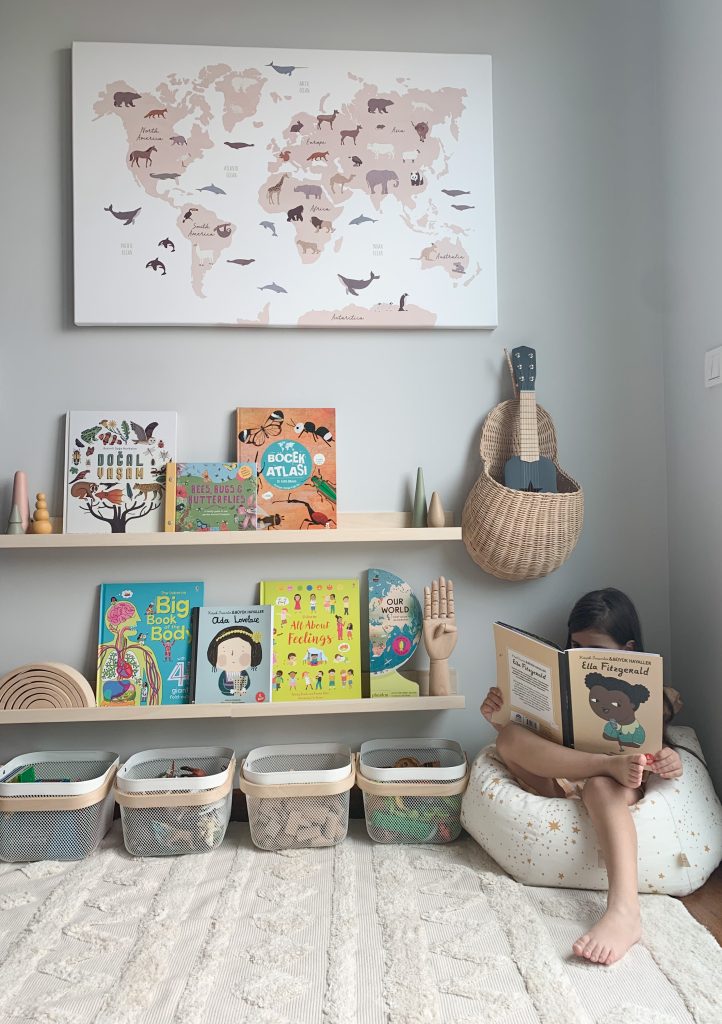
Once you’ve decluttered the play space you can go ahead and arrange the toys/materials you’ve decided to keep for the moment on the activity shelves. Depending on the child, you may want to opt for a combination of passive toys such as blocks, roads, cars, stacking toys, and more Montessori-aligned activities that target the development of cognitive and pre-writing skills. If you have toys that are battery-operated with flashing lights and sounds, try removing the batteries and using them without these features for a while. There is no right or wrong and every household is unique. Work with what you already have instead of buying more.
“A place for everything and everything in its place”
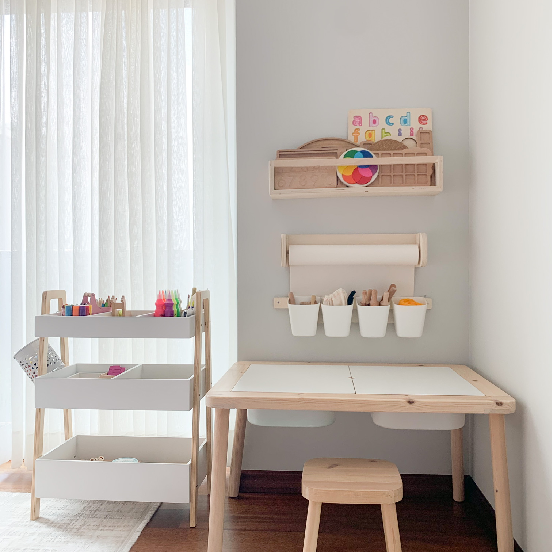
Make sure you have a functional space where everything has a designated place and your child knows where it goes. For example, art supplies go on the art caddy, books go on the bookshelf, activities go on the shelf. Keep it simple for both you and your child. Always model putting activities/ toys back when done using them and encourage your child to do the same.
Because of their strong sense of order, children, in particular toddlers, thrive in orderly environments. If there is a place for everything, the child can learn where items go and is more likely to put them back where they belong. Toddlerhood is the perfect time to start to form healthy habits of putting toys away once they are done using them. It takes a bit of practice in the beginning but it’s worth it.
Keep realistic expectations. Young children need to be modeled and shown exactly what it looks like and it needs to be manageable for the child. Instead of giving them a general prompt such as “go clean your playroom”, break it up into small tasks that the child can handle. Try instead, “How about we do team work! You put the stuffed animals in the basket while I put away the blocks”.
The last step is to rotate toys and materials/ activities based on your observation of the child’s developmental needs and interests.
Toy rotations offer a number of very important benefits. They reduce clutter and make it easier to clean up; create a calming and inviting space; make old toys feel new and exciting again; prevent overwhelm from too many choices; increase focus and deeper engagement; foster creativity and promote more independent play.
There is no exact prescription when it comes to rotating. Find what works for your family and stick to that. Eventually you will be able to involve your child in this process too.
For more tips on how to observe your child, please see my article on this topic here.
COPYRIGHT © 2023 WONDERHOUSE OF LITTLES LLC. ALL RIGHTS RESERVED
Love all these helpful tips
So happy to hear that!!
Thank you very much Sara! This was a huge help. Im going to redo our playroom using your guide.
I just have a technical advice. Could you please make the color or the thickness of the font a bit more easy to read? some of the letters looked so washed off. Thank you again for all that you share with us 🙏
Aww thank you soo much for the feedback! I appreciate the advice. Did you use mobile or desktop? I’m so excited to see what you create for your daughter in the bedroom! I loved the entryway :)!! Tag me, I’d love to see it! and don’t hesitate to reach out for advice if you need! Happy to help!.